When someone needed a plumber, a dentist, or a coffee shop, they used to search Google and scroll
through the results. Increasingly, they skip that step entirely. They ask ChatGPT, Perplexity, or
Google's AI directly: "Who is the best emergency plumber near me?" — and the AI answers
with one to three names.
If your business is one of those names, you win the customer before your competitors even appear.
If it isn't, you are invisible — no matter how well you rank in traditional search. This guide
covers exactly how AI assistants pick which local businesses to recommend, and the practical
steps to become one of them.
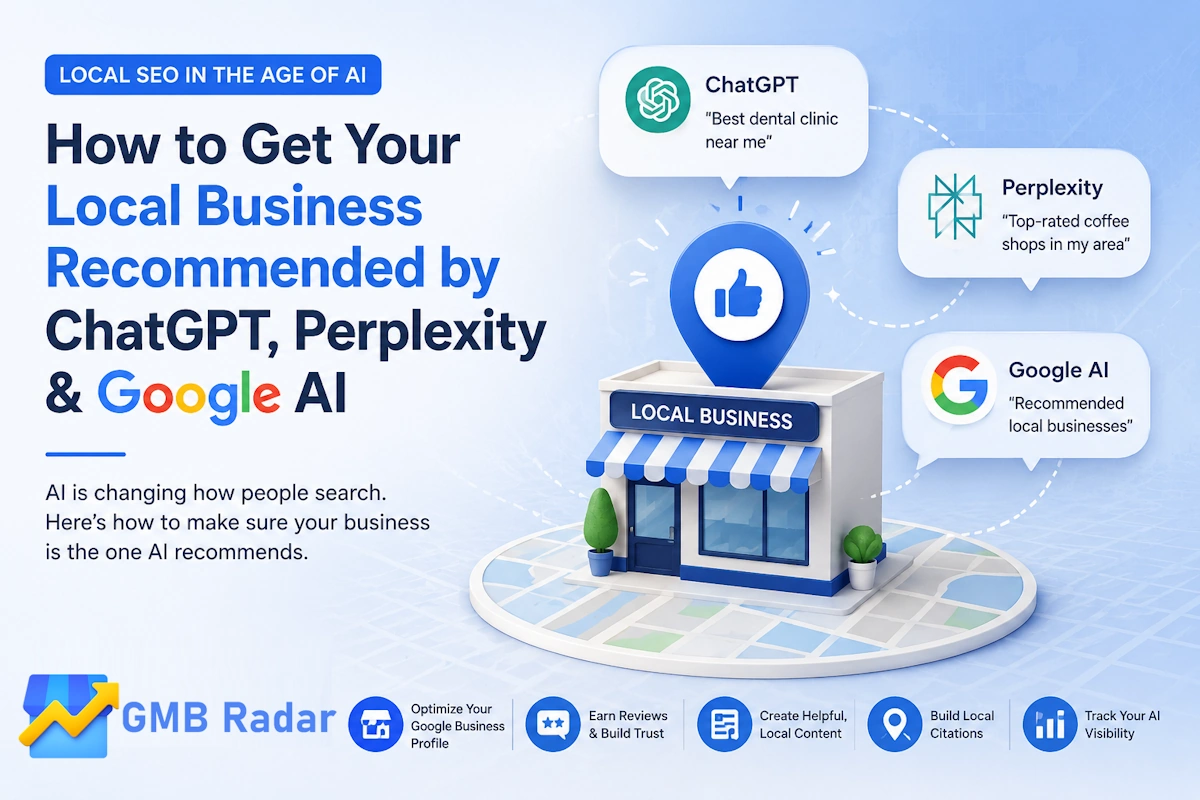
How AI Assistants Choose Which Businesses to Recommend
Each AI platform builds its answers from different sources, and understanding this is the key to
optimizing for them:
- Google AI Overviews, AI Mode, and Gemini pull heavily from Google Maps and
your Google Business Profile. Google has now
connected Gemini directly to Business Profiles,
so your GBP data flows straight into AI answers.
- ChatGPT is strongly influenced by Bing's web index, plus review platforms
and directories it retrieves at the moment a question is asked.
- Perplexity crawls the live web and favors well-structured, recently updated
pages.
Here is the part most business owners miss: AI search is dramatically more selective than
traditional search. Google's local pack shows three businesses for every query, and a typical
established business appears in the 3-pack for a meaningful share of its target searches. AI
assistants, on the other hand, recommend only a tiny fraction of businesses — industry studies in
2026 put ChatGPT's recommendation rate at low single digits.
An AI assistant can only recommend a business it can find, parse, and trust. Every step below
strengthens one of those three.
Step 1: Make Your Google Business Profile Airtight
Your Google Business Profile is still the single most important data source — it feeds Google's
AI features directly and acts as a trust reference for other platforms. Complete every field:
a specific primary category, relevant secondary categories, services with descriptions, service
areas, up-to-date hours, attributes, and a natural, keyword-aware business description.
Then check consistency. Your business name, address, and phone number (NAP) must be identical
across your GBP, website, Apple Maps, Bing Places, Yelp, and Facebook. AI models cross-reference
sources before recommending a business — and when the data disagrees, they simply pick a
competitor whose data doesn't.
Step 2: Treat Reviews as a Trust Filter, Not a Score
AI platforms don't rank businesses on a smooth curve from 3.9 to 4.7 stars. They use reviews as
a confidence threshold: enough volume, strong recency, and a rating that clears roughly the
4.2–4.3 mark. Below that threshold, you are rarely considered at all.
Quality matters more than it does on Google. Detailed, experience-driven reviews that mention the
specific service and location ("replaced our water heater same-day in DHA Phase 5") give AI
models extractable evidence of what you do and where. Generic five-star reviews with no text
carry far less weight. We covered this pattern in depth in our analysis of
how ChatGPT recommends local businesses.
Practical actions: ask every satisfied customer for a review, encourage them to mention the
service they received, respond to every review, and don't neglect Yelp, Facebook, and
industry-specific review sites — ChatGPT and Perplexity read those too.
Step 3: Make Your Website Quotable
AI answers are assembled from text the model can extract cleanly. Give it sentences worth
quoting:
- Answer the question in the first 40–60 words of every service page.
"We provide 24/7 emergency plumbing across Toronto, with an average response time of 45
minutes" is a sentence an AI can lift directly into its answer.
- Add LocalBusiness schema (and FAQPage schema where relevant) so machines can
parse your name, address, hours, and service area without guessing.
- Build a genuine FAQ page answering real customer questions — pricing,
timelines, service areas. FAQ content is disproportionately cited in AI answers.
- Create one page per service and per location instead of a single generic
page. Specific pages win specific questions.
Step 4: The Bing Shortcut Most Businesses Miss
ChatGPT's web search leans heavily on Bing's index. That means an afternoon of Bing work
directly improves your ChatGPT visibility: set up Bing Webmaster Tools, submit your sitemap,
and claim your Bing Places listing.
While you're at it, check your robots.txt and firewall rules. Make sure you aren't blocking AI
crawlers such as GPTBot, PerplexityBot, or Google-Extended. You cannot be recommended if the
crawler can't read your site.
Step 5: Earn Mentions Beyond Your Own Properties
AI models trust businesses that other sources vouch for. Mentions in local news, "best of
[city]" roundups, community forums, and reputable industry directories all build the external
reputation layer that AI systems weigh heavily — often more heavily than Google does.
One genuine mention on an authoritative local site beats ten low-quality directory submissions.
Publishing something genuinely useful — a local pricing guide, an original data point — is the
most reliable way to earn these mentions.
Step 6: Measure Where You Actually Stand
You need two separate checks here, because no single tool covers both layers yet.
First, your Google Maps foundation. Google's AI features and Gemini are grounded
in Maps data, so weak map visibility limits your chances there before anything else. A
local rank tracker
shows exactly where your Google Business Profile ranks across a grid of points covering your
entire service area — not just next to your office. If you rank #3 near your location but #18
two kilometers away, that's the foundation to fix first.
Second, a manual AI audit. AI visibility itself can't be tracked the way map
rankings can, so check it by hand once a month: ask ChatGPT, Perplexity, and Gemini the exact
questions your customers would ask ("best [your service] in [your city]"). Record whether you're
mentioned, what is said about you, and who beats you. Then study what the winners have that you
don't — usually more recent reviews, better-structured pages, or stronger third-party mentions.
Final Thought
AI search hasn't replaced local SEO — it has raised the bar on top of it. The businesses getting
recommended by ChatGPT, Perplexity, and Google AI are the ones with complete and consistent
business data, a healthy stream of detailed reviews, machine-readable websites, and real
third-party credibility. Do the work above, track your rankings across your whole service area,
and you give every AI engine a reason to make you the recommendation.
 GMB Radar