 GMB Radar
Google Maps rankings are constantly evolving. In 2026, success depends on more than just your business profile — it’s a combination of proximity, authority, reviews, and increasingly, AI-driven signals. Here’s a complete breakdown of what actually matters.
What Are Google Maps Ranking Factors?
Google Maps ranking factors determine how your business appears in the Local Pack and Google Maps results. These factors help Google decide:
- Which businesses to show
- In what order
- For which searches
Traditionally, rankings were based on relevance, distance, and prominence. In 2026, those still matter—but new signals like AI visibility and content structure are becoming increasingly important.
Top Google Maps Ranking Factors in 2026
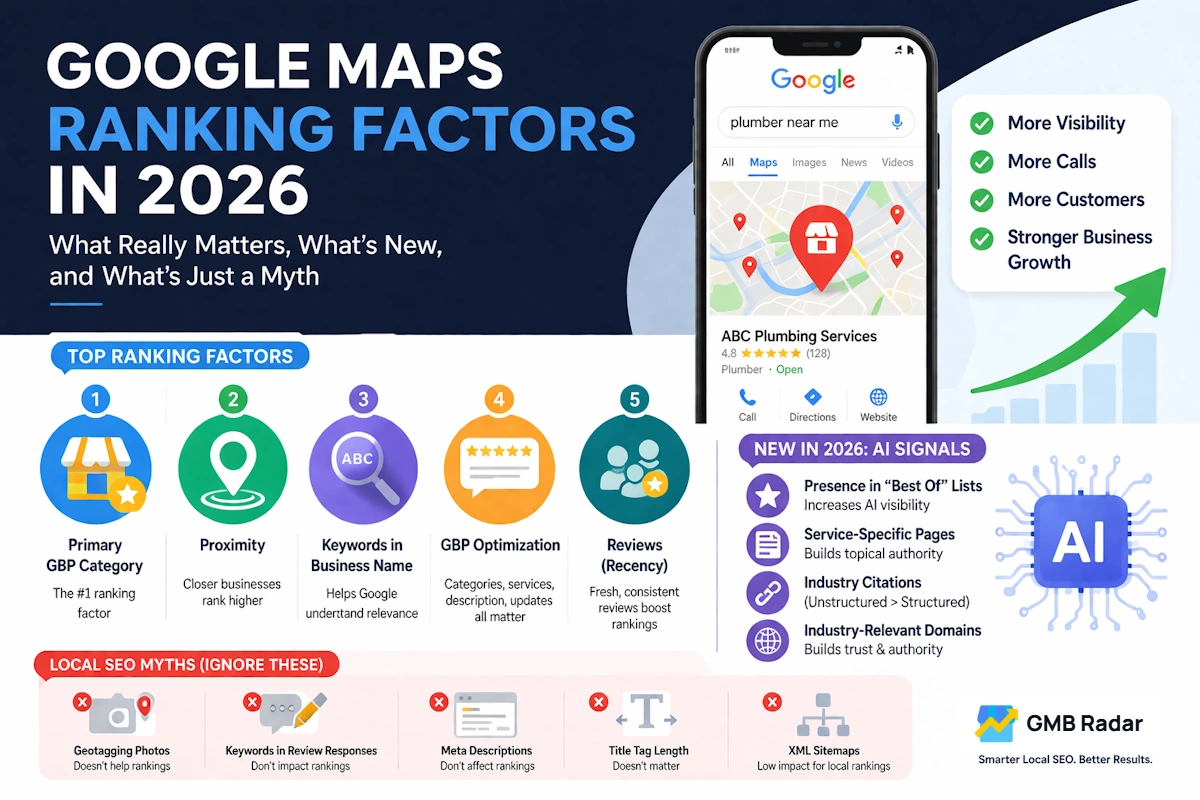
1. Primary Google Business Profile Category
Your primary category is still the strongest ranking factor. It tells Google exactly what your business does and determines which searches you are eligible to appear in.
Choosing the wrong category can significantly limit your visibility, even if everything else is optimized.
2. Proximity to the Searcher
Distance remains a major factor. Businesses closer to the searcher are more likely to rank higher.
While you cannot directly control proximity, you can improve visibility by building strong location relevance through content and service area targeting.
3. Keywords in Business Name
Keywords in your business name continue to influence rankings. However, this should be done naturally and within branding guidelines to avoid penalties.
4. Google Business Profile Optimization
A fully optimized Google Business Profile improves your chances of ranking in Maps. Key elements include:
- Accurate categories
- Complete services list
- Business description
- Regular updates
These signals directly impact local rankings, but they do not necessarily influence organic rankings in the same way :contentReference[oaicite:1]{index=1}.
5. Reviews and Review Recency
Reviews are one of the most important ranking signals in 2026—especially how recent they are.
- Consistent review flow is critical
- Recent reviews boost visibility significantly
- Stopping reviews can cause ranking drops
Instead of collecting reviews occasionally, businesses should build a continuous review acquisition process.
Website Signals That Impact Google Maps Rankings
Dedicated Service Pages
One of the most powerful ranking factors across Maps, organic, and AI search is having a dedicated page for each service.
For example, instead of one general page, create:
- /plumbing-repair
- /toilet-repair
- /pipe-repair
This helps Google better understand your expertise and improves visibility across all search types :contentReference[oaicite:2]{index=2}.
Local Keyword Optimization
Including city and location keywords in your content helps Google connect your business to specific areas.
Backlinks and Authority
Links from other websites remain a strong ranking factor. High-quality backlinks improve both organic and local visibility.
New in 2026: AI Search Ranking Factors
With the rise of AI-powered search (like AI Overviews and LLM-based results), new ranking signals are emerging.
1. Presence on “Best Of” Lists
AI systems heavily rely on curated lists such as “best plumbers in [city]”.
Getting featured on these lists increases your visibility across AI-driven search platforms.
2. Service-Specific Content Structure
Websites with clear service pages and structured content perform better in AI search results.
3. Industry Citations
Citations still matter and come in two forms:
- Structured citations (directories)
- Unstructured citations (mentions in blogs or news)
Unstructured mentions are harder to get but often more powerful.
Local Services Ads (LSA) Ranking Factors
In many industries, Local Services Ads now generate a large portion of leads.
Key Factors
- Budget and bidding
- Review recency
- Response time to leads
- Service selection accuracy
- Call handling quality
Google evaluates how businesses handle calls and leads. Poor handling or rejecting leads can reduce visibility in LSA results :contentReference[oaicite:3]{index=3}.
Common Google Maps Ranking Myths
Myth 1: Geotagging Photos Improves Rankings
This is a widely shared tactic but has no real impact on rankings.
Myth 2: Keywords in Review Responses Help
Adding keywords in replies to reviews does not improve rankings and is considered ineffective.
Myth 3: Meta Descriptions Affect Local Rankings
Meta descriptions do not directly influence rankings.
Myth 4: Title Tag Length Matters for Local SEO
There is no strict character limit requirement for ranking purposes.
Tracking Your Google Maps Rankings
Understanding ranking factors is only half the equation—you also need to track performance.
What to Track
- Google Maps rankings
- Organic rankings
- Keyword performance over time
- Competitor visibility
Track Maps + Organic Rankings Together
Most local searches show both Maps results and organic listings. Tracking only one gives you an incomplete picture.
You can use the GMB Radar Organic + Map Pack Rank Tracker to monitor both in one place.
If you need help getting started, check the step-by-step tracking guide.
Final Thoughts
Google Maps ranking in 2026 is no longer about a single factor. It requires a combination of:
- Accurate business information
- Consistent reviews
- Strong website structure
- Local relevance signals
- Authority across the web
Businesses that focus on long-term, consistent optimization—not shortcuts—are the ones that dominate both Maps and organic results.
If you want to see where you currently stand, start tracking your rankings and identify the gaps. That’s where real growth begins.