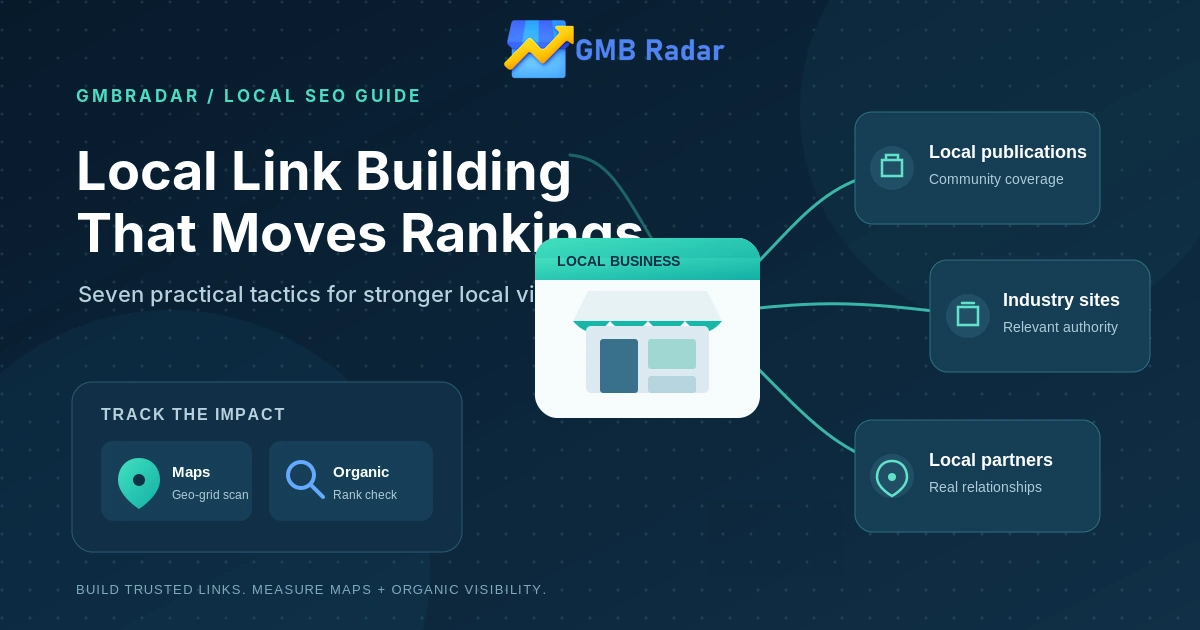
Local Link Building Without a Big Budget: 7 Tactics
Local SEO
Google Business Profile
Sunday, November 8, 2026
TL;DR — The Short Version
The easy, free link sources (forums, social posts, blog comments, generic directories) are mostly nofollow or low value. The links that move rankings now take money, relationships, or something genuinely worth linking to.
Links still matter. Google says local ranking depends on relevance, distance, and prominence, and prominence draws on information from across the web, including links.
Don’t buy links to manipulate rankings. It breaks Google’s spam policies and it isn’t worth the risk.
Small businesses have an edge big brands can’t copy: real local relationships. This guide ranks seven tactics by effort and payoff.
Measure it. Run a baseline geo-grid scan and organic rank check, build links, then rescan after four to eight weeks and compare.
If you run a local business, or manage SEO for dozens of them, you already know the frustrating part of local link building: the links that are easy to get no longer count for much, and the links that do count seem to cost money.
This guide explains why that happened, why links still matter for both your website and your Google Maps rankings, and what a small business can realistically do about it. It finishes with something most link building guides skip: how to measure whether your effort moved your rankings, on Google Maps and in regular organic search.
For a local business, the best links come from places only a local business can reach.
Why Local Link Building Feels Pay-to-Play Now
Big brands have a simple playbook: spend. A national company can run a PR campaign, publish a study, place interviews on news sites, and pay for sponsored features. Many of those placements are paid in one way or another. So is a lot of the guest content on blogs, where site owners charge a fee to publish an article with a link in it.
A local plumber, dentist, or café can’t compete at that scale. And the free routes that small businesses used to rely on have mostly dried up:
💬
Forums & Q&A sites
Links are usually nofollow, heavily moderated, or removed. Years of spam pushed these sites to lock links down.
📱
Social profiles & posts
Links are nofollow. A profile link is useful for traffic and discovery, but it doesn’t pass the same signal as an editorial link.
✍️
Blog comments & guestbooks
A relic of old-school link building. Today they’re low value at best and a spam signal at worst.
📂
Generic directories
A basic listing helps with citations, but most directories add little link value, and mass-submitting to low-quality ones can look manipulative.
One clarification, because it matters for credibility: it isn’t true that no site will ever link to you for free. Editorial links still happen every day. What changed is that the cheap, scalable, copy-and-paste links stopped being worth much. What’s left is links that take money, relationships, or something genuinely worth linking to.
Local businesses can’t win on money. But relationships and local relevance are where they have the advantage, and that’s what the rest of this guide builds on.
Why Links Still Matter for Local SEO
It’s tempting to write links off as an old tactic. Google’s own guidance suggests otherwise. According to Google, local results are based mainly on three factors: relevance, distance, and prominence. Prominence is how well known a business is, and Google says it draws on information about your business from across the web, such as links, articles, and directories. Google also notes that your position in web results is a factor, so standard SEO best practices apply to local search as well.
For your website’s organic rankings
Your service pages and location pages compete in regular organic results, not just in the map pack. For those rankings, links from trusted, relevant sites remain one of the clearest ways to show Google that your pages deserve to rank. When you’re up against a competitor with a stronger link profile, great on-page content alone often isn’t enough.
For Google Maps and the local pack
Your Business Profile points to your website, and that website is part of the picture Google builds about your business. Google doesn’t publish a formula, and nobody outside Google can isolate the effect of a single link on a map ranking. What you can say is that a stronger, more locally relevant web presence supports prominence. And you can test it on your own listing by measuring before and after, which we cover below.
What about nofollow links?
Since March 2020, Google has treated nofollow, sponsored, and ugc link attributes as hints rather than strict instructions. A nofollow link from a respected local site isn’t worthless. It can send real visitors, build your name recognition in the area, and may still contribute to how Google understands your business. Don’t turn down a good local link just because it’s nofollow.
Local citations vs. local backlinks
These two get mixed up constantly. Both help, but they do different jobs.
Local citation
Local backlink
What it is
A mention of your business name, address, and phone number (NAP), with or without a link
A link from another website to yours
Where it appears
Directories, data aggregators, and listing sites
Local news, partner sites, associations, blogs, event pages
Main job
Confirms your business details are accurate and consistent
Signals that other sites trust and recommend your website
How you get it
Submit or claim a listing
Earn it through relationships, community involvement, or useful content
Get your citations right first, because it’s the easy part. Then treat backlinks as the longer game.
What Doesn’t Work (and Can Hurt)
When links feel hard to get, shortcuts start looking attractive. Most of them aren’t worth it:
Buying links outright. Google’s spam policies cover paying for links that pass ranking signals. Best case, the links are ignored. Worst case, you invite a manual action or lose rankings you already had.
Cheap “100 backlinks” packages. These typically come from link farms and private blog networks, built to be discovered by exactly the systems Google uses to catch them.
Irrelevant links from far away. A link from a random site on the other side of the world says nothing about your local relevance.
Mass reciprocal link swapping. Google lists excessive link exchanges among its link scheme examples. A few natural cross-references between partners are fine. Systematic swapping is not.
Repeating the same keyword-rich anchor. If every link says “best emergency plumber in [city]”, it looks engineered. Natural links mostly use brand names, page titles, and plain phrases.
⚠️ A note on sponsorships
A sponsor logo on a charity’s or club’s website is a normal, widely accepted way to be recognized for genuine community support. But if an arrangement is really just a payment for a link, Google’s guidance says paid links should be marked with rel="sponsored" or nofollow. Support causes because they’re worth supporting, and treat any link as a bonus.
The Local Link Building Playbook: 7 Tactics Ranked by Effort and Payoff
Here’s how the seven tactics below compare. Start with the ones in the top left. They take the least effort for the most return, and most local businesses haven’t tried them.
An editorial judgment, not hard data. Your own mix of contacts and budget will shift where each tactic lands.
1
Supplier, manufacturer, and partner pages
Effort: lowPayoff: high
The brands and companies you already work with often run “find a dealer”, “certified installer”, “where to buy”, or “our partners” pages, usually organized by city or region. Those pages are relevant, local, and trusted. Most small businesses never ask to be listed.
Examples: an HVAC company and the equipment brands it installs, a restaurant and the local producers it buys from, a roofer and the shingle manufacturers that certify installers.
How to do it: list every brand, supplier, and franchisor you work with. Check each one’s site for dealer, installer, or partner pages. If you qualify and you’re missing, email their partner or dealer support team.
Tip: give them your business name, address, phone number, and website exactly as they appear on your Google Business Profile, so the listing also reinforces your citations.
2
Chambers of commerce, associations, and trade bodies
Effort: low to mediumPayoff: medium to high
Local chambers, business improvement districts, and industry associations usually have a member directory, and some feature members in newsletters, event pages, and spotlights. These are real organizations with real local audiences.
Complete your member profile fully, with a description, a link to the right page of your site, and a logo.
Look beyond the directory. Event listings, “member news” pages, and ribbon-cutting posts often carry links too.
Membership dues are a legitimate cost of belonging, not a link purchase. Join because the organization is useful for your business, and treat the link as a bonus.
3
Sponsorships and community involvement
Effort: mediumPayoff: medium
Youth sports teams, charity runs, school events, local festivals, and community scholarships all need sponsors, and most publish a sponsor page. For a local business this is also good marketing in its own right.
Choose causes inside your service area, so the links come from sites that are locally relevant.
Ask up front how sponsors are recognized: “Will we be listed on your sponsors page, with a link to our website?”
Offer more than money where you can: your time, your service, or a prize. Organizations tend to write about people who show up.
4
Unlinked mentions
Effort: lowPayoff: medium
If you’ve been in business a while, someone has probably already mentioned you without linking: a local news story, an event recap, a partner’s blog post, a “best of” list. Asking for the link is the easiest outreach you’ll ever do, because they already like you.
Find them: search Google for "Your Business Name" -site:yourwebsite.com and scan the results for pages that mention you but don’t link. Search the owner’s name too.
Keep finding them: set up a Google Alert for your business name so new mentions reach your inbox.
Ask politely: thank them for the mention, and ask whether they’d add a link so readers can find you easily. Keep it to two or three sentences.
5
Cross-promotion with complementary businesses
Effort: mediumPayoff: medium
A plumber and an electrician, a wedding venue and a photographer, a mover and a cleaning service: these businesses serve the same customers at different moments, so their audiences overlap without competing.
Create real value together: a “preferred vendors” page, a joint moving checklist, a referral partnership, or a co-hosted local event.
Write about each other because it helps customers, not because you agreed to swap links. A natural recommendation is worth more than a reciprocal link page.
6
Local press with a real hook
Effort: medium to highPayoff: medium to high
Local newspapers, hyperlocal news sites, community blogs, radio shows, and podcasts need stories every week. A generic “we offer great service” pitch gets ignored. A story with a hook gets picked up.
Hooks that work: a business anniversary, a new apprenticeship program, a charity project, a local first, or a data point only you have, such as “what we saw in [city] this winter”.
Expert commentary: offer a quote when something local is in the news, like storm damage, new regulations, or a seasonal problem in your trade.
The pitch: three sentences, a specific angle, and a photo or quote ready to use. Follow up once, then move on.
After publication: if the article mentions you without linking, see tactic 4.
7
Linkable local assets
Effort: highPayoff: high
Instead of asking for links to a page nobody has a reason to cite, create something other local sites will want to reference. This takes the most work, but it keeps earning links long after you publish it.
A local cost guide: “How much does [service] cost in [city] in 2026?”, with real price ranges. Realtors, bloggers, and local forums love citing these.
Area or neighborhood guides: useful for newcomers, and linked to by local organizations and community sites.
Local rules and permits explained: “How to get a permit for a deck in [city]” answers a question people really search for.
Seasonal checklists tied to your climate: winter prep, storm readiness, spring maintenance.
Original local data: a simple survey, or numbers from your own jobs, summarized clearly.
Then promote it to the people who would actually use it: neighborhood associations, local bloggers, chambers, realtors, and community newsletters. If you’re in a trade like roofing, our local SEO guide for roofers shows how local service content fits into the bigger ranking picture.
A simple outreach email you can adapt
Whatever tactic you use, the best outreach is short, specific, and useful to the person reading it.
Subject: Quick suggestion for your [page name] page
Hi [Name],
I run [Business], a [service] company serving [area]. I came across your [page or article] and found it useful, especially [specific detail].
We recently published [asset], which covers [what it covers]. If you think it would help your readers, it would fit well alongside [specific section]. Either way, thank you for putting your page together.
[Your name]
💡 Find your best targets by looking at who’s already winning
Look at the businesses ranking in the top three for your main keywords. Run their websites through any backlink checker and note which local sites link to them: chambers, local publications, event pages, supplier pages. Every local link they have that you don’t is a ready-made target list.
A Realistic 90-Day Local Link Building Plan
You don’t need to do everything at once. Here’s a pace a busy owner or a small agency can actually sustain:
Days 1–14: baseline and research. Choose three to five target keywords. Run a baseline Maps grid scan and record your organic rankings for the same keywords. List your suppliers, associations, and partners, find unlinked mentions, and build a target list from competitors’ local links.
Days 15–45: easy wins. Contact suppliers and partners (tactic 1), complete chamber and association profiles (tactic 2), and request links for unlinked mentions (tactic 4). Start conversations with one or two complementary businesses (tactic 5).
Days 46–75: build something. Publish one linkable local asset (tactic 7), commit to one sponsorship or community event (tactic 3), and send your first local press pitch (tactic 6). Rescan around week six to eight and log the results.
Days 76–90: promote and review. Share your asset with the people who’d use it, follow up on open outreach, and run a second rescan. Compare it with your baseline and decide where to double down.
How to Measure Whether Local Link Building Is Working
This is the part most guides skip, and it’s why many business owners give up on link building. Links work slowly. Without a baseline, you can’t tell whether a link helped, a competitor slipped, or nothing changed at all.
Because links can influence both your website and your map visibility, measure both:
Choose your keywords. Pick the searches that matter: service plus city, and the “near me” variants your customers use.
Run a baseline geo-grid scan. A geo-grid shows where you rank at many points across your service area, not just from your address. A single-location check hides the fact that you might rank first next to your office and not at all two miles away.
Record your organic rankings. Track the same keywords for your website, including the specific pages you’re building links to.
Keep a link log. For each link you earn, note the date, the source, the page it points to, and whether it’s followed.
Rescan after four to eight weeks. Rankings take time to respond to new links, so check too early and you’ll see nothing. Repeat at around twelve weeks.
Compare the two reports. Look at changes in coverage, not just the center point.
An illustrative example: the same keyword scanned across a 5×5 grid before and after a link building campaign.
What to look for in the comparison
Coverage: how many grid points rank in the top three, and in the top ten. Expanding coverage outward from your location is usually the first visible sign.
Average rank: a falling average across the whole grid is more meaningful than a single point improving.
Organic position of the linked page: a link to a service page may lift its organic ranking before your Maps ranking moves, so check both.
Everything else you changed: new reviews, profile edits, and website updates can all affect rankings. Note them in your log so you don’t credit the wrong cause.
Be honest about what this shows. It’s evidence of correlation over time, not proof that one link caused one ranking change. But a consistent pattern across several keywords and several rescans is a strong signal that your effort is paying off, and a much better basis for decisions than guesswork.
GMBRadar tracks both sides of this: geo-grid scans for your Google Maps rankings and organic ranking scans for your website, so you can run the baseline and the follow-up for the same keywords in one tool.
If you’re an agency
Link building is easy to undervalue because the results are slow and indirect. Showing a client a baseline report, a link log, and a before-and-after comparison makes the work visible. GMBRadar’s white label local rank reports are built for exactly that kind of client reporting.
Common Local Link Building Mistakes
Starting with outreach instead of a baseline. If you don’t record where you rank today, you can’t show progress later.
Chasing quantity. Five relevant local links are worth more than fifty unrelated ones.
Linking only to the homepage. Point links at the service and location pages you want to rank, where it makes sense for the source.
Giving up after one round. Most outreach gets no reply. Follow up once, and keep a list of what you’ve tried.
Ignoring the rest of your presence. Links help most when your Google Business Profile, reviews, and website content are already solid. If you’re working on being recommended by AI assistants too, our guide on getting your local business recommended by ChatGPT, Perplexity and Google AI covers how those systems pick businesses.
Frequently Asked Questions
Do nofollow links help local SEO?
They can. Google has treated nofollow as a hint rather than a strict instruction since March 2020. Even when they pass little ranking value, nofollow links from respected local sites can bring visitors and raise your visibility in the community, so they’re worth pursuing when the site is relevant.
How many backlinks does a local business need?
There’s no fixed number. It depends on your competition. Check the backlink profiles of the businesses ranking above you, and look at how many local, relevant sites link to them. Your goal is to close that gap with quality links, not to hit a number.
How long does local link building take to work?
Expect weeks to months. A reasonable approach is to rescan your rankings four to eight weeks after links go live, and again at around twelve weeks. Competitive markets can take longer.
Is it okay to pay for links?
Paying for links that pass ranking signals goes against Google’s spam policies. Genuine sponsorships and memberships are different, but if money is changing hands mainly for a link, it should be marked as sponsored. The safer route is to earn links through relationships and useful content.
Do local citations count as backlinks?
Not exactly. A citation is a mention of your business name, address, and phone number, and it may or may not include a link. Citations help confirm your details are consistent, while backlinks are links from other sites that signal trust in your website. You want both.
Do website backlinks improve Google Maps rankings?
Google says prominence, which includes information from across the web such as links, is one of the factors behind local rankings. The exact effect of any single link isn’t published, so the best way to know is to measure your own Maps rankings before and after, using a geo-grid scan.
Final Thoughts
Local link building is harder than it used to be, and it’s fair to say it favors businesses with big budgets. But the playbook that works for small businesses is built on things money can’t buy: local relationships, community involvement, and content that’s genuinely useful to the people around you.
Start with the low-effort tactics. Record where you rank today. Build a few good links, give them time, then measure the result across both Google Maps and organic search. That’s how you find out which tactics are worth repeating.
Ready to set your baseline? Create a free GMBRadar account and run your first scan before you send your first outreach email.
If you run a local business, or manage SEO for dozens of them, you already know the frustrating part of local link building: the links that are easy to get no longer count for much, and the links that do count seem to cost money. This guide explains why that happened, why links still matter for both your website and your Google Maps rankings, and what a small business can realistically do about it.
When someone needed a plumber, a dentist, or a coffee shop, they used to search Google and scroll through the results. Increasingly, they skip that step entirely. They ask ChatGPT, Perplexity, or Google's AI directly: "Who is the best emergency plumber near me?" — and the AI answers with one to three names.
Google's announcement is framed as a productivity win for small businesses. But for anyone in local SEO, it's something bigger: a fundamental shift in how Google surfaces, evaluates, and rewards your listing.
 GMB Radar